
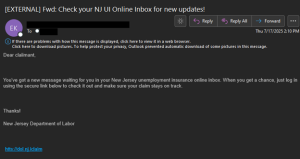
In June, the NJCCIC reported on an SMS phishing (SMiShing) scam where threat actors impersonated the New Jersey Department of Labor (NJ DOL). We recently received reports of a new phishing scam imitating the NJ DOL and claiming to be an urgent message regarding the target's unemployment claim. This phishing campaign employs typosquatting to make the link appear legitimate and uses a sense of urgency to persuade targets to click the provided link.
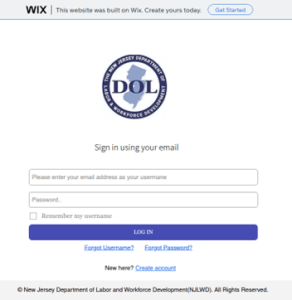
Upon following the URL, targets are directed to a website that impersonates the NJ DOL login page. Any credentials or information provided will be forwarded to the threat actors behind the attack.
Recommendations
- Avoid clicking links and opening attachments in unsolicited emails and instead navigate directly to official websites.
- Exercise caution with unexpected emails from unverified senders, including those claiming to be from government organizations but whose email address does not use the .gov top-level domain.
- If a user is unsure of a message’s legitimacy, navigate to the associated organization’s official website to find the correct contact information.
- Look for red flags like unexpected requests for personal information, suspicious links, or urgent requests to take action.
- If you submit your account information to a fraudulent site, reset your password and enable multi-factor authentication (MFA) immediately.
- If you submit personally identifiable information, such as a Social Security number, visit identitytheft.gov for guidance.
- If you submit financial information, contact your banking institution immediately to prevent unauthorized transactions and reset PINs, if applicable.
- Review the Don't Take the Bait! Phishing and Other Social Engineering Attacks NJCCIC product for more information on common phishing and social engineering attacks.
- Report phishing and other malicious cyber activity to the NJCCIC and the FBI's IC3.